I built a system to see how customers actually find us.
I tracked 748 Shopify installs to learn where merchants found Podifai, what they searched for, how AI described us, and which sources retained best.
I built a small system to track where 748 installs came from, what merchants searched for, what AI thinks we're good at, and which sources produced merchants who stayed.
I'm a designer. Claude and Codex wrote most of the code. But building it taught me more about attribution than any article did.
I included the measurement decisions because that is where most of the mistakes live.
TL;DR
- Of 748 installs, App Store Search produced 254—the largest source I could prove. Another 277, or 37%, could not be attributed at all.
- Website-attributed traffic produced 71 installs, but those merchants retained better. Among eligible installs, 77.8% were still installed after seven days, compared with 65.5% from App Store Search.
- From May onward, the homepage produced most website install clicks. The comparison and solution pages meant to create demand barely registered.
- Merchants spelled "Podifai" seven different ways. Their non-branded searches were more useful because they revealed the jobs they were trying to do: live preview, image upload, engraving, and more.
- Podifai appeared in 34.2% of 120 AI checks. AI associated us with "cheap" and "free," but missed us for jewelry, apparel, product options, and image upload—jobs the product already supports.
- Shopify Partner events provide the install and uninstall truth. GA4 and BigQuery reconstruct acquisition paths. APIs and scheduled Puppeteer runs track App Store rankings and AI visibility.
Where 748 installs came from
From March through July 17, 2026, Podifai recorded 748 Shopify installs.
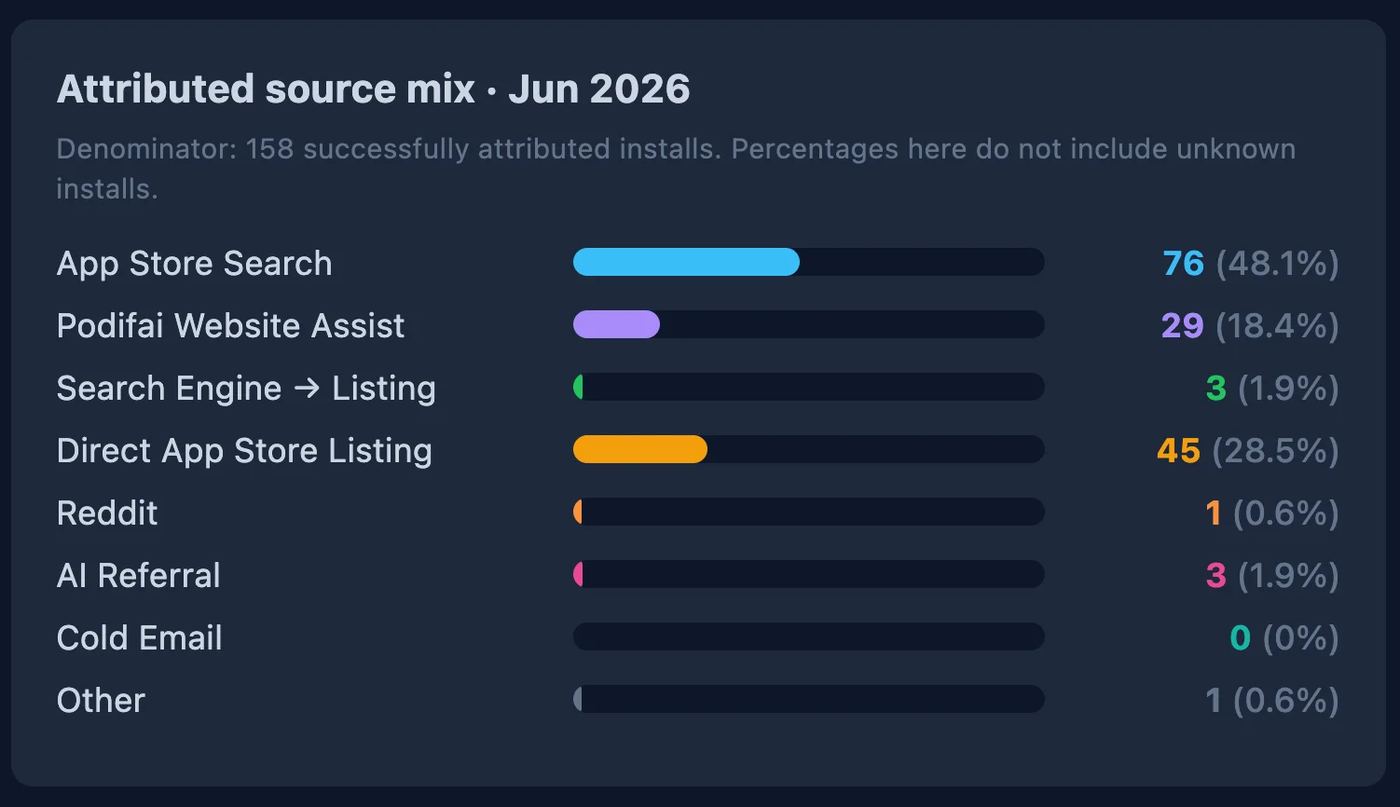
Of those, 471 had enough evidence to assign an acquisition source:
- App Store Search: 254 installs, or 34.0% of all installs
- Direct App Store Listing: 104, or 13.9%
- Podifai Website: 71, or 9.5%
- Search Engine to App Listing: 12, or 1.6%
- Reddit: 10, or 1.3%
- Direct AI Referral: 9, or 1.2%
- Other attributable sources: 11, or 1.5%
- Unattributed: 277, or 37.0%
Among attributable installs, App Store Search accounted for 53.9%.
That makes App Store Search the largest acquisition channel I can prove. It does not mean other channels did no work.
An AI answer, Reddit discussion, or Google result may introduce Podifai first. The merchant may later search for our name inside the App Store. The final install will say App Store Search, while the earlier influence disappears.
AI visibility and AI-attributed installs are not the same thing. The same is true for content visibility and website-attributed installs.
How this is measured
- Install totals come from Shopify Partner API events; GA4 supplies the attribution evidence.
- App Store Search requires
surface_type=search;surface_detailcontains the keyword. - Direct App Store Listing means a click with no identifiable source.
- Website and search-engine sources require a matching UTM or referrer.
- Reddit and AI referrals are referrer or
utm_sourcematches, so stripped referrers remain invisible. - Installs are joined to the nearest click from the same
user_pseudo_id, from 72 hours before to 10 minutes after.
Where the 37% actually goes
"Unattributed" is not one failure. It is three:
- Shopify recorded an install, but GA4 has no matching install event. The tag may not have fired, or a blocker or unsupported browser stopped it.
- GA4 has the install, but there is no listing click inside the 72-hour window. The visit may have happened earlier or on another device.
- There is a listing click, but nothing on it is classifiable. No search surface, UTM, or referrer survived.
Think about a merchant who reads a Reddit thread on her phone on Sunday. On Tuesday, she opens her laptop, searches for Podifai in the App Store, and installs. My dashboard says App Store Search. The Reddit thread that did the work leaves no trace.
Retention by acquisition source
I joined acquisition data with uninstall events and ranked mature cohorts by retention. Here, 7-day retention means the app was not uninstalled within 7 days. It does not mean the merchant used the product or reached value.
Among sources with a meaningful seven-day sample, website-attributed merchants retained best:
- Podifai Website: 77.8% across 63 eligible installs
- App Store Direct: 66.7% across 27
- App Store Search: 65.5% across 177
- Direct / Unknown: 64.4% across 90
- Search Engine / SEO: 64.3% across 42
- App Store Autocomplete: 61.7% across 60
- AI Referral: 54.5% across 22
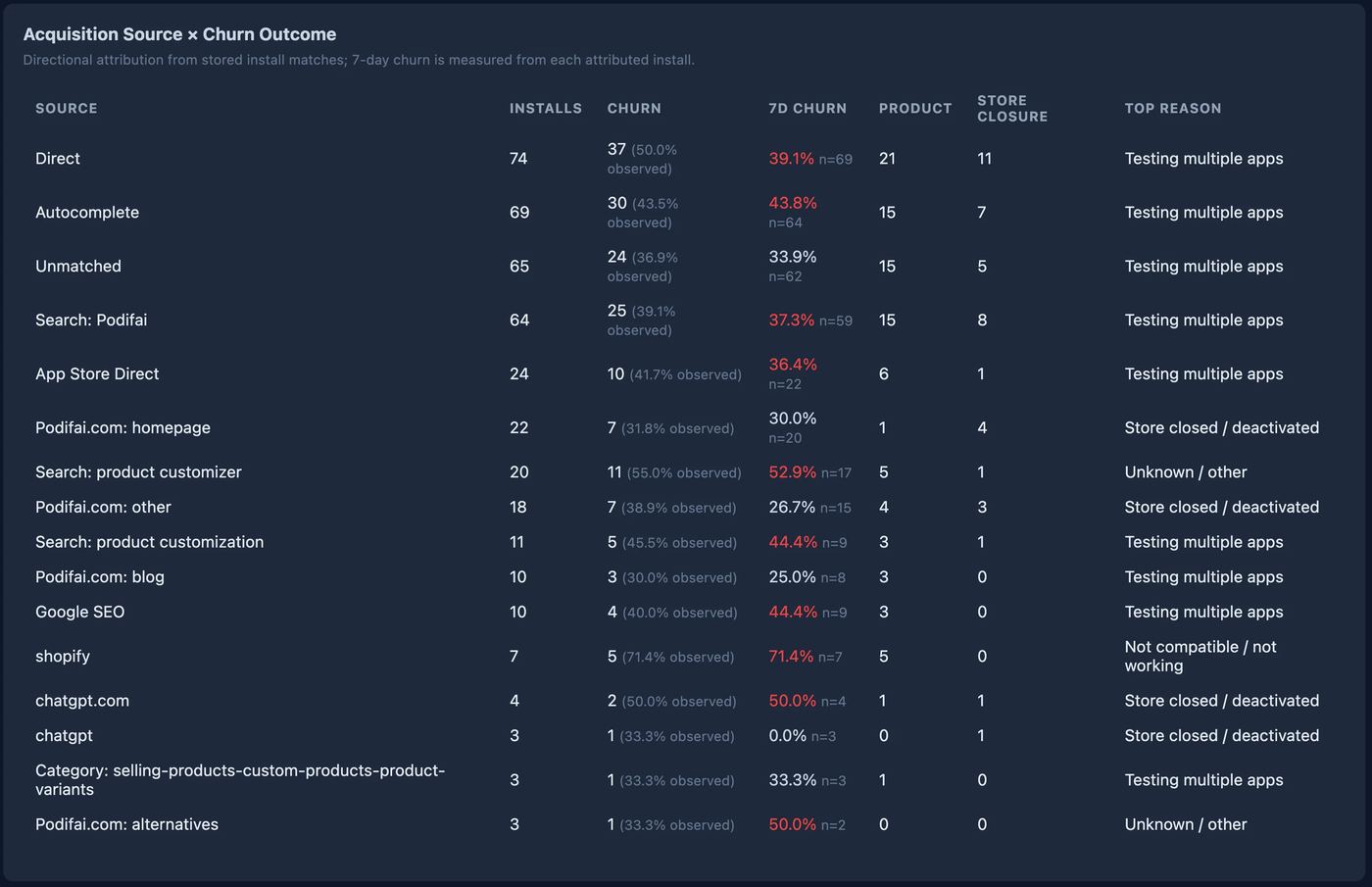
Reddit showed 80% seven-day retention, but only five installs had completed the observation window. That sample is too small to call it the best source.
The 30-day view kept the same order. The website remained highest at 73.9%, while AI referral remained last at 44.4%.
How this is measured
- Retention uses Shopify install, uninstall, and reactivation events keyed by shop domain.
- A shop enters a 7 or 30-day cohort only after completing that observation window.
- Current activity and continuous retention are tracked separately.
- Podifai test stores are excluded.
The pages merchants viewed before installing
Not every website page represents the same intent. I group them like this:
- Already aware: Homepage
- Evaluating: Pricing and alternative pages
- Validating a use case: Feature and solution pages
- Learning: Blog posts, directories, and reports
- Trying something useful: Free tools
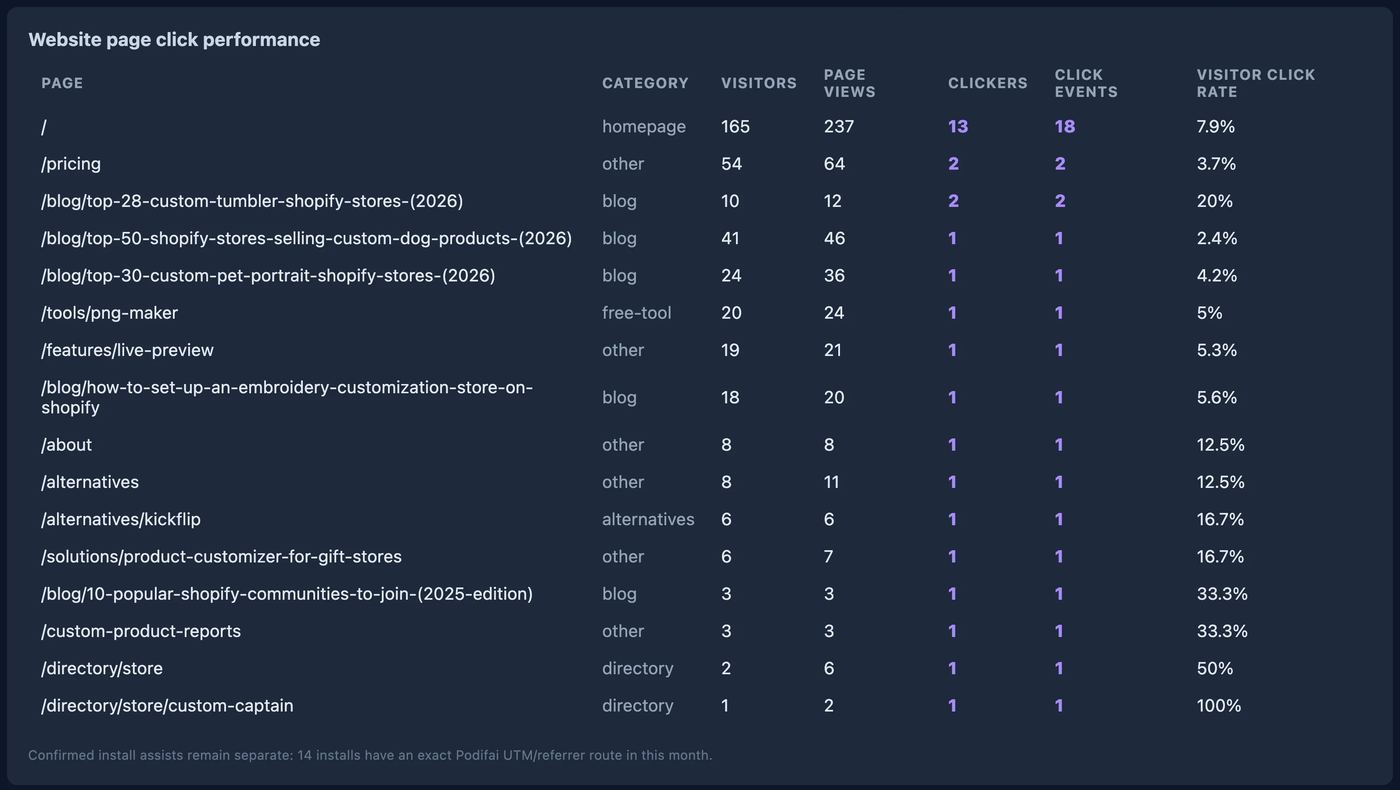
From May onward, the homepage produced most website install clicks, suggesting that the website often closes demand created somewhere else.
Comparison and solution pages, which are meant to create demand, barely register.
The better question is not only whether content drives installs. It is which pages move a merchant from learning to evaluating, and which ones give them enough confidence to install.
How this is measured
- Page categories come from URL prefixes such as
/blog/,/alternatives/, and/tools/. - Visitor paths use the previous 30 minutes of the same GA4 session, with repeats removed and the last four pages kept.
- The final click page is treated as an assist, not automatically as the acquisition source.
What merchants searched for
Branded searches meant that merchants already knew Podifai. They searched for it using seven spellings: Podifai, podify, podfai, podif, podi, podifal, and poifai.
Non-branded searches were consistently the larger half. In June, App Store Search produced 76 installs: 34 branded and 42 non-branded.
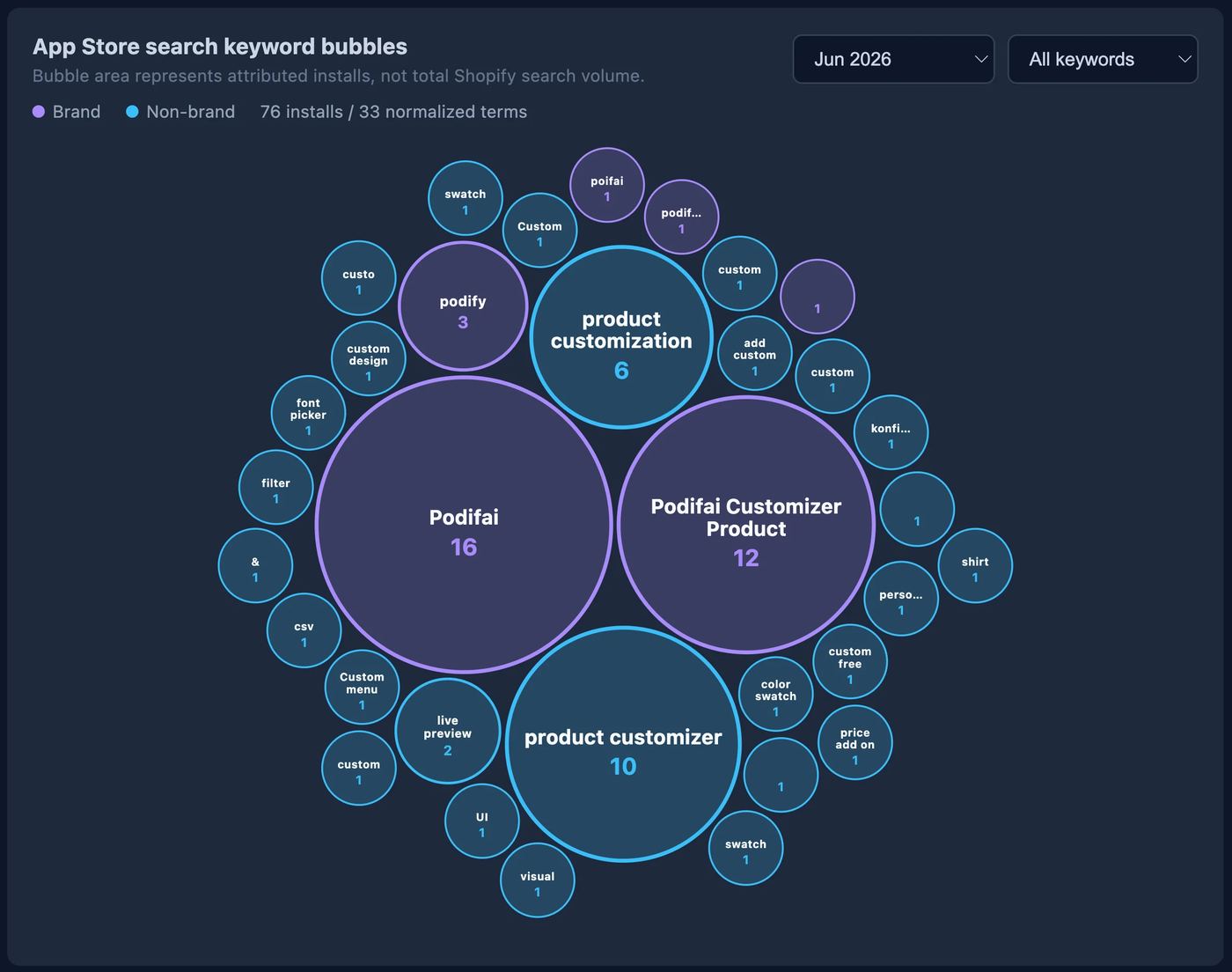
Those non-branded searches were more useful because they showed how merchants described the problem before they knew our name:
- Category: product customizer, product customization, product options
- Capability: live preview, photo upload, price add-ons, color swatch
- Workflow: add logo or text custom product, custom product builder
- Vertical: jewelry, engraving, neon sign customizer
- Localized language: konfigurator, personalizador, produktoptionen
These searches reflected different levels of awareness. Category searchers wanted comparisons. Workflow searchers wanted to see their exact job. Jewelry and engraving merchants sometimes did not yet know what kind of software they needed.
Right now, they all get the same App Store listing.
The harder question is: how do customers describe their problem before they learn our product language?
Those words should shape App Store copy, landing pages, documentation, onboarding, and the roadmap. A keyword is not only an SEO target. It is a small record of how a customer thinks.
How this is measured
- Branded searches are identified using spelling patterns that cover common Podifai variations.
- Search terms are cleaned before grouping, so different technical versions of the same phrase count as one keyword.
AI visibility
Merchants no longer search only Google or the Shopify App Store. Some ask ChatGPT, Claude, or Gemini a complete buying question and consider the brands in the answer.
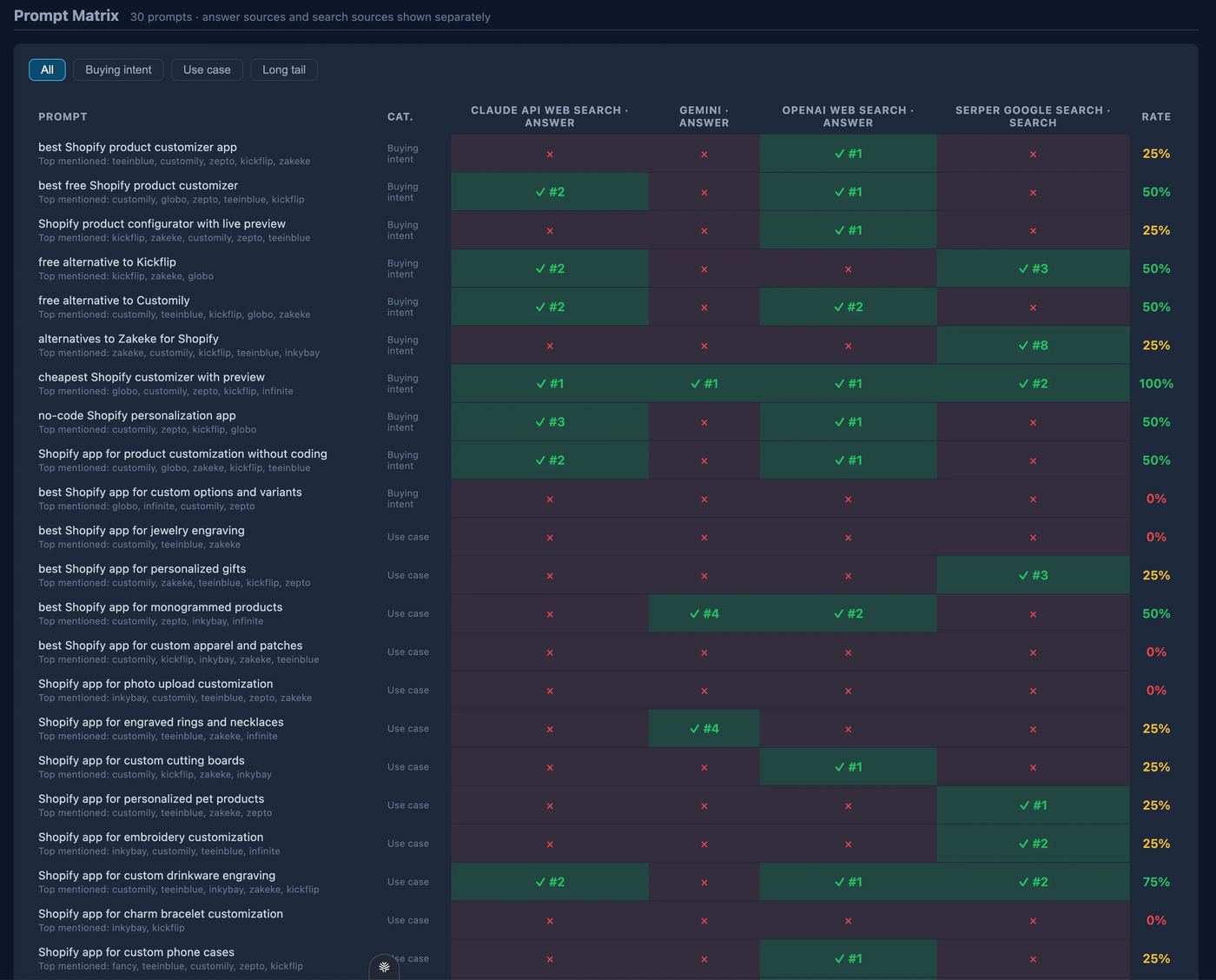
I built another view around 30 merchant-style prompts. The same prompts run across several AI sources on a schedule. The system records which brands appear and in what order.
These are questions a merchant might realistically ask:
- best free Shopify product customizer
- free alternative to Kickflip
- how to add image upload to Shopify product page
In the latest snapshot, Podifai had a 34.2% mention rate across 120 prompt-and-source checks. Its Brand Voice Share was 15.2%, second in the tracked competitor set.
Podifai appeared in all four tracked sources for "cheapest Shopify customizer with preview." It appeared in three of four for prompts about a free customizer, a Kickflip alternative, drinkware engraving, and dynamic pricing for engraving.
None of the four sources mentioned Podifai for jewelry engraving, engraved rings and necklaces, charm bracelets, apparel and patches, product options and variants, or image upload.
The pattern was clear: AI saw Podifai as a budget option, not yet as the answer for specific businesses such as engraved-ring sellers.
That does not mean every AI system knows nothing about our features. It means this benchmark found a consistent gap in commercially relevant questions.
This changes what I would publish next. I do not need another general page about product customization. I need useful pages for the specific jobs where merchants ask questions and Podifai is missing from the answer.
How this is measured
- APIs handle Gemini, OpenAI, Claude, and search; Puppeteer handles consumer AI interfaces.
- The scorer records mentions, position, competitors, and cited sources.
- Each run verifies that web search is actually enabled.
What the system still cannot tell me
Attribution tells me where a merchant probably came from. Search terms show how they described the problem. AI visibility shows whether Podifai entered the answer. Retention shows whether the app stayed installed.
None of those tells me why the merchant chose Podifai or whether they reached value.
Did they choose the free plan, live preview, dynamic pricing, or image upload? Did they create and publish a customizable product? Did they stay because the product worked, or because they had not uninstalled it yet?
Session replays in PostHog can answer part of this. Watching one merchant add a text field and close the tab without publishing tells me something no retention chart can.
A prompt you can use for your own product
I run a [product type] for [target customer]. My measurable acquisition sources include [sources]. My analytics stack includes [tools]. Design an acquisition intelligence system that answers: 1. Where did each conversion originate? 2. What search term, content page, or recommendation preceded it? 3. Which branded and non-branded themes drive conversion? 4. How visible is the product in AI-generated answers? 5. Which commercially important questions do AI systems fail to associate with the product? 6. Which sources produce the highest seven-day and thirty-day retention? 7. Which conversions remain unattributed? 8. What activation events should I track to understand why customers chose and kept the product? Return the required events, data model, classification rules, dashboards, validation tests, and a phased implementation plan.
Start with one question you cannot currently answer. Ask it on a schedule.
If you run a Shopify store and want to try the product behind this system, install Podifai from the Shopify App Store.