6 AI Chatbots for Shopify Compared: Merchant Fit, Features and Real Costs
Compare six Shopify AI chatbots by team size, sales and support workflows, plan limits, integrations and worked cost scenarios.
A chatbot that recommends a dress, an agent that changes a shipping address, and a helpdesk that routes conversations solve different problems. Buying the cheapest entry plan can leave you paying for an app that cannot handle your actual workload. This comparison focuses on merchant fit, meaningful feature differences, plan boundaries, ongoing work and the reasons to choose one candidate over another.
How we researched this comparison
We reviewed official product pages, help documentation and Shopify App Store listings on October 7–8, 2026. Each product has a public website screenshot captured in a cloud browser and a vendor-provided App Store image. We verified documented capabilities and published limits; we did not run six installations against one catalog or independently measure accuracy, speed, revenue lift or setup time. Merchant-fit judgments and cost examples below are our analysis, with assumptions stated explicitly. An undocumented capability is marked unverified, not absent.
Partnership disclosure: Podifai and Algoshop have a content partnership. Algoshop published an introduction to Podifai and receives prominent placement here. Its second position is editorial placement, not a performance score. We apply the same requirements for evidence, limitations and plan checks to every product.
Which apps belong on your shortlist?
| App | Start here when… | Distinctive buying question | Main constraint |
|---|---|---|---|
| Tidio / Lyro | You want AI and human conversations in one support workspace | Do you need Lyro, the human inbox, Flows, or a combination? | Separate packages and allowances; the free Lyro quota is not recurring |
| Algoshop | Your store wants proactive outreach alongside product guidance | Do campaign cards and social AI channels match your selling process? | Message, catalog and outreach quotas; social AI starts at Essential |
| Gorgias AI Agent | Your support team needs governed actions in connected tools | Can existing support processes become configured AI skills? | Implementation ownership and ticket/automation billing |
| Rep AI | A merchandising or growth owner can tune proactive selling | Do you need Sales Skills, Support Skills, or both? | Traffic-based listing prices and separately scoped capabilities |
| Chatty | A small team wants chat, FAQs and an explicit upgrade path | Does Basic meet the need, or do you need Pro shopping features? | Seats, catalog coverage and AI conversation overages |
| Manifest AI | Product knowledge and existing helpdesk connections matter | Can the data and handoff setup support your specific catalog? | Paid production price and entitlements need a written quote |
The product sections below link the evidence behind this shortlist. Sales and support overlap across these apps: being support-oriented does not mean an app cannot recommend products, and offering sales chat does not establish that it can execute a refund.
Match the app to your team and store size
Revenue alone is a weak sizing measure. Record monthly visitors, AI-eligible conversations, human-handled tickets, active products and variants, support seats, storefronts and required languages. A high-revenue store with a narrow catalog can be simpler to support than a smaller store with thousands of variants. The following team sizes are illustrative buyer profiles, not vendor eligibility rules.
Founder-led store, one or two people: start by comparing Chatty and Tidio for answering questions and reaching a person. Include Algoshop if proactive campaigns are the main reason to buy. Prioritize what happens overnight and when the allowance runs out. A lower subscription is not a saving if nobody has time to maintain answers or respond to escalations.
Growing brand, roughly three to ten support or ecommerce staff: split the decision by owner. A support lead should compare Tidio with Gorgias; a growth or merchandising lead should compare Algoshop with Rep. Chatty Pro is also relevant where its seat, catalog and shopping limits fit. Test a promotional traffic spike and an unhappy customer, not just a normal product question.
Established brand with an existing helpdesk, multiple stores or specialist workflows: first evaluate adding AI to the current system. If Gorgias is already the working inbox, its native AI deserves a baseline trial before adding another layer. For any alternative, require proof of routing, conversation continuity and the exact integration behavior. Enterprise suitability, security requirements and service commitments need separate verification; no revenue threshold or brand logo establishes them.
1. Tidio / Lyro: AI and human support in one workspace
Positioning and merchant fit: Tidio is a candidate for a founder-led store growing into a support team, or a team consolidating chat and other conversations. Its value is the connection between AI answers and a human workspace. Our recommendation is strongest when you want both, rather than a standalone promotional widget. The Shopify listing describes a shared inbox plus order context for agents.
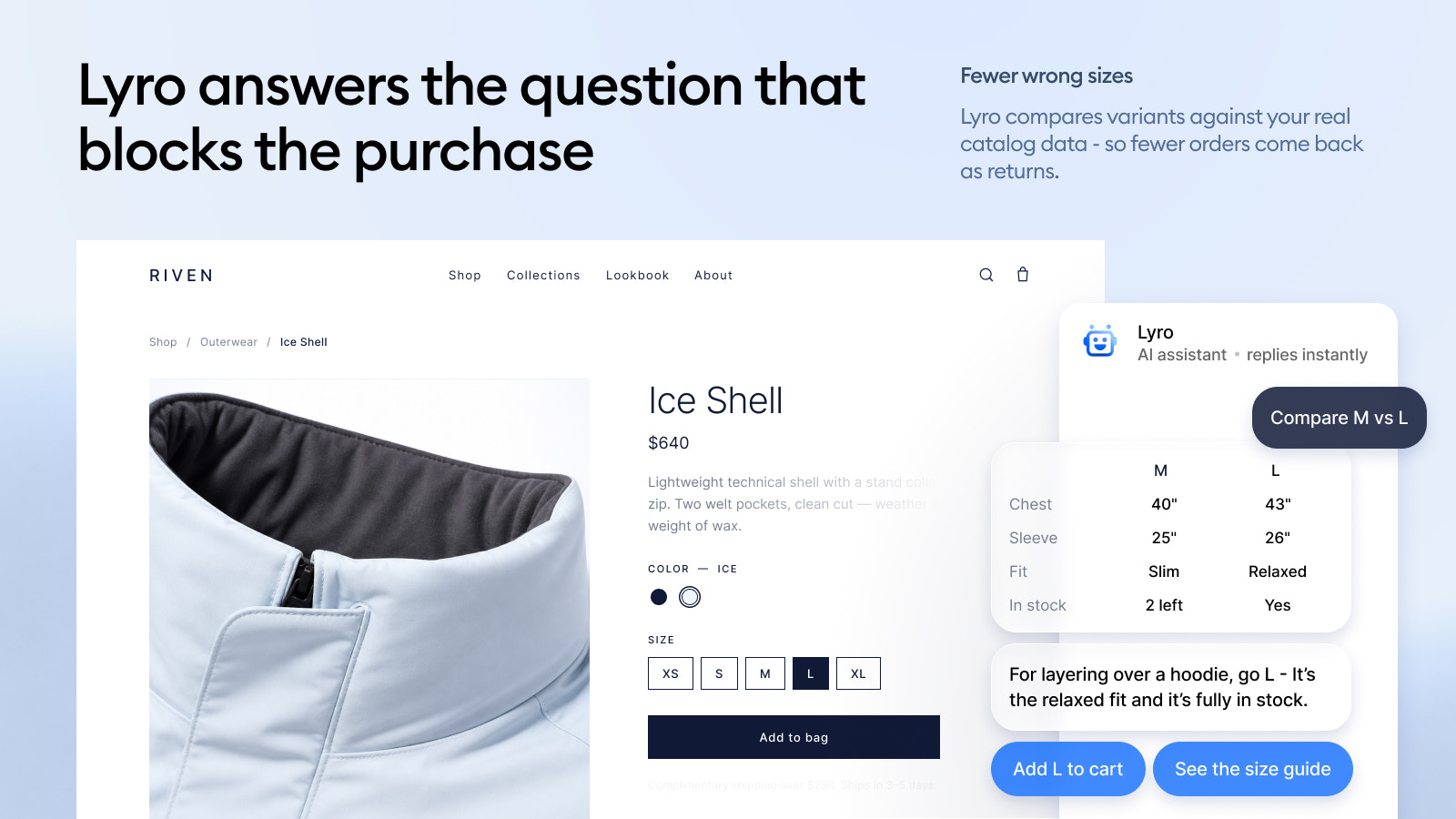
Meaningful capabilities: Lyro’s Shopify shopping features include follow-up questions, product cards, stock awareness, cart-aware suggestions and adding a selected product size to the cart. That makes it relevant to apparel and catalogs with variants, not just FAQ support. These are vendor-documented functions, not an accuracy result from our own test. Tidio also documents configurable Actions for connected-system tasks; available templates and custom setup determine the actual workflow.
Human handoff and setup: configure what should happen when Lyro lacks knowledge or a shopper asks for an agent. Tidio documents different online/offline options, including transfer or ticket creation. Assign someone to own those rules alongside knowledge sources and permitted actions. The work includes testing the fallback destination, not just turning on a chat bubble. Handoff documentation.
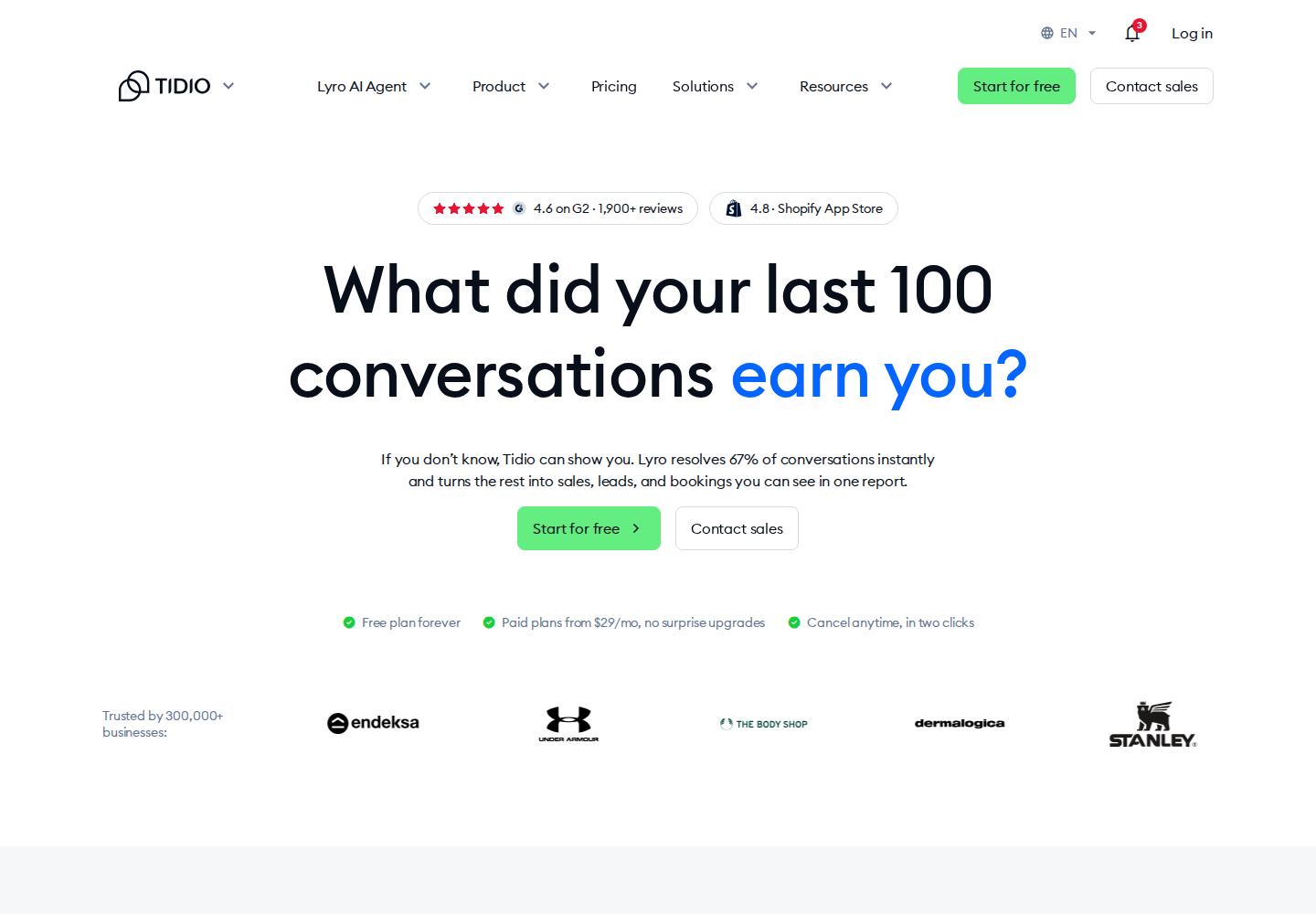
Plan and cost: the App Store lists Lyro from $39/month, Customer Service from $29 and Flows from $29. These are separately scoped packages; do not assume a $29 subscription includes the whole stack. The pricing page describes Lyro starting at 50 monthly conversations and up to ten agents on self-serve plans. Its Growth tier adds permissions and automatic assignment; seats alone do not establish those controls. Its quota documentation describes 50 free Lyro conversations as a one-time allowance, with paid monthly renewal. Confirm the chosen tier before budgeting sustained AI usage.
Choose it over / rule it out: prioritize Tidio over a campaign-focused shortlist if the inbox and escalation workflow are central. Compare it directly with Chatty on required seats, catalog controls and the combined subscription. If you only need a lightweight product campaign, the wider workspace may add unnecessary setup. Keeping another helpdesk is a separate purchase question: Tidio describes Lyro Connect on Plus and Premium in its product information; do not presume the entry plan covers that deployment.
2. Algoshop: proactive campaigns and sales conversations
Positioning and merchant fit: Algoshop describes itself as an ecommerce sales assistant, with product guidance, outreach and human takeover. We would shortlist it for a small or growing brand whose ecommerce owner wants to manage purchase questions and storefront interventions together. Its product overview explicitly distinguishes this focus from a general-purpose helpdesk. Team fit here is our assessment, not a claim about the size of its customer base.
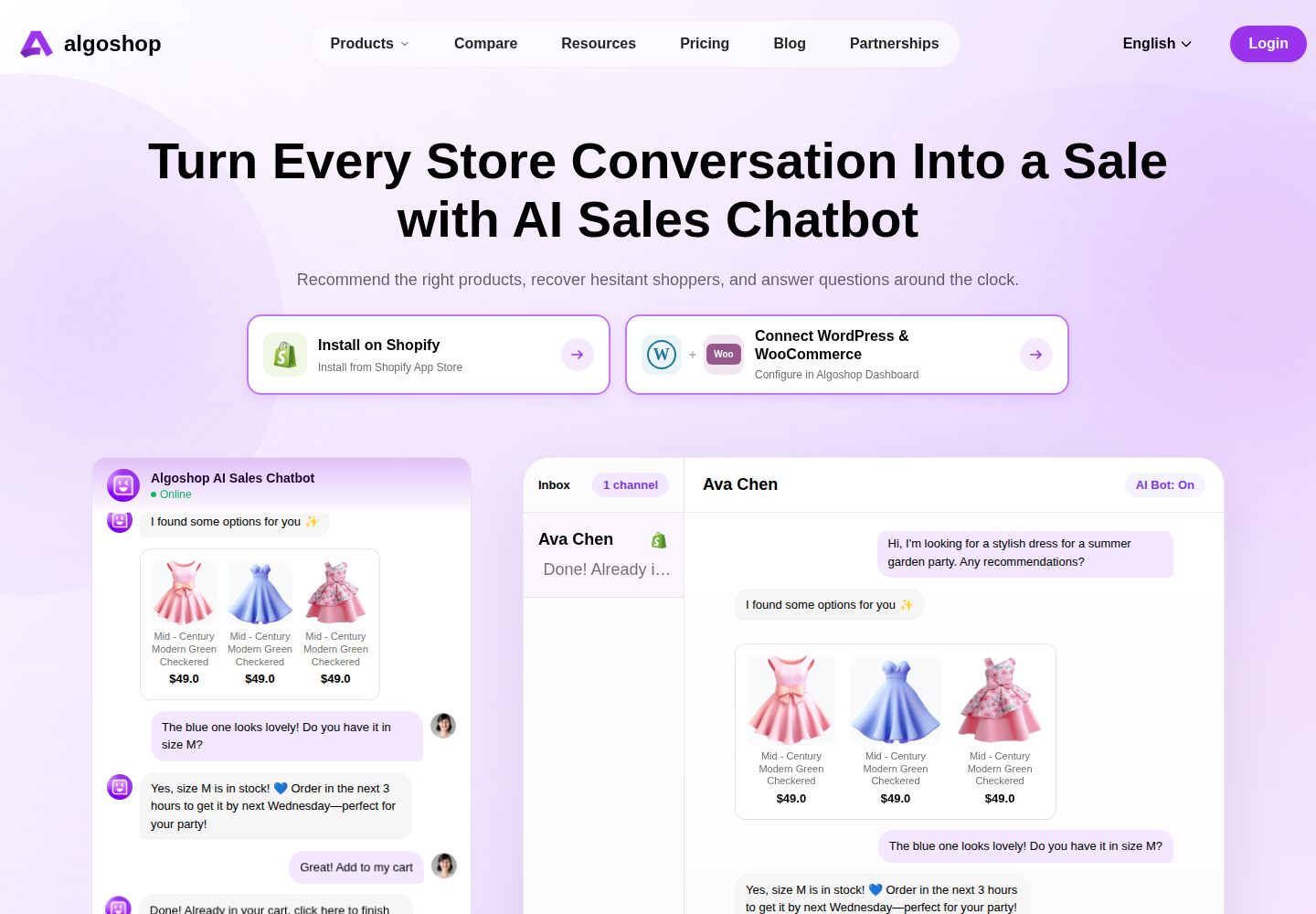
Meaningful capabilities: the Shopify listing describes behavior-triggered outreach cards for recommendations, coupons and countdowns alongside live chat and order tracking. The useful merchant question is which intervention helps a particular shopper: product guidance on a complex item, or a promotion near purchase. Evaluate the card rules and presentation against your current pop-ups so that multiple campaigns do not compete for attention.
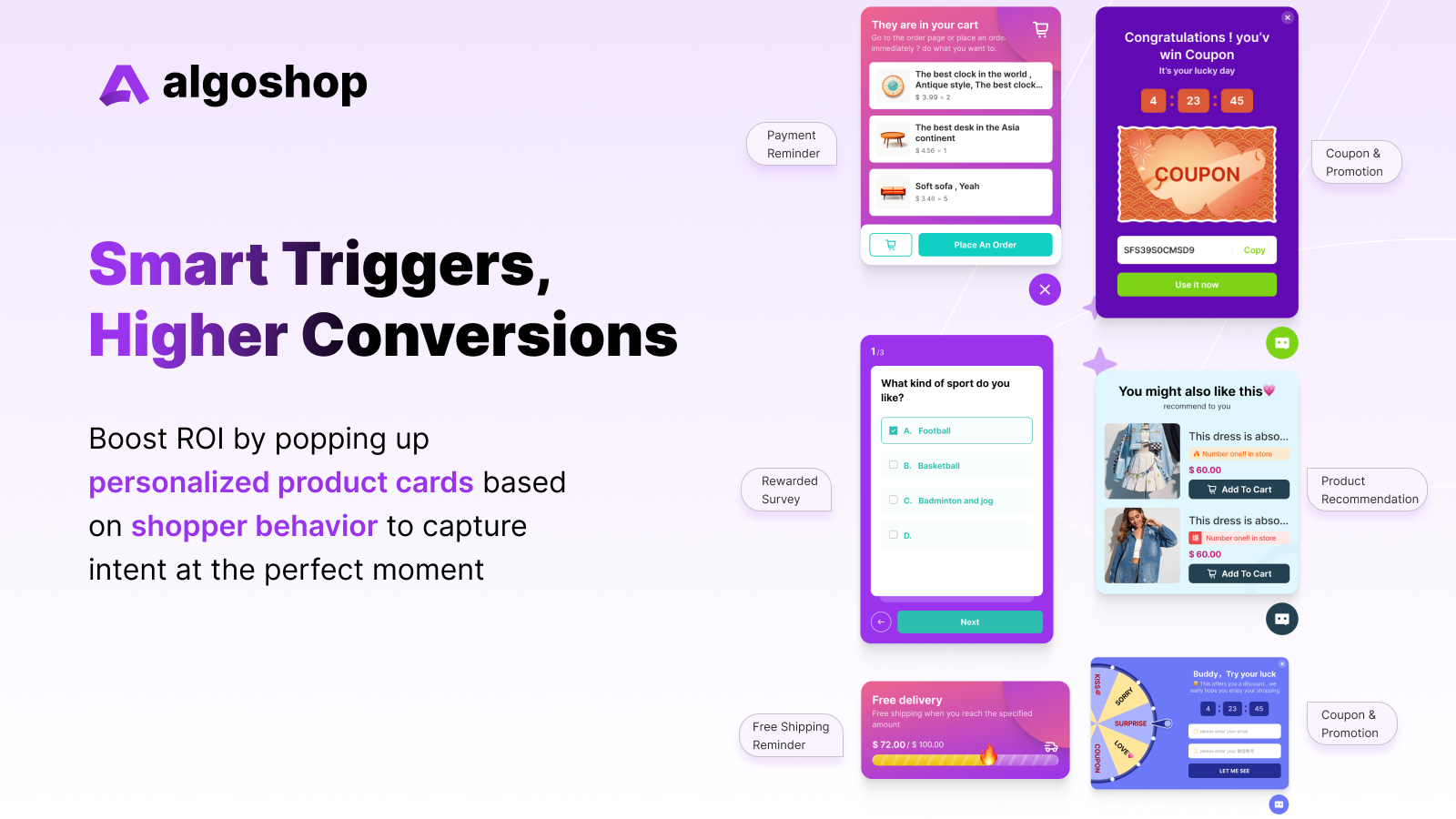
Plan boundaries that matter: Starter is $39.90/month with 1,000 AI messages, 1,000 synced products and 5,000 outreach impressions. Essential is $79.90 with 3,000 messages, 3,000 products and 50,000 impressions; its listed social AI channels are WhatsApp, Messenger and Instagram. Ultimate is $199.90 with 10,000 messages and unlimited product sync. These are App Store allowances, not equivalent to a conversation-based plan.
Knowledge, branding and limits: the pricing matrix puts file uploads and manual Q&A on paid plans, URL knowledge import and conversation export at Essential, and removal of Algoshop branding at Ultimate. It also lists separate order-tracking allowances. Its FAQ says AI pauses after the quota is consumed while manual takeover remains available. For a small team, quota monitoring and an offline fallback are therefore part of operating the app.
Choose it over / rule it out: compare Algoshop first when campaign formats, social channels and message allowances fit your store. Compare Rep if you want to tune distinct behavioral sales skills and budget around traffic. A brand requiring automated refunds, subscription changes or granular support-team permissions should not infer those capabilities from “AI sales chatbot”; we did not verify them in the reviewed Algoshop materials. Its campaign focus is a reason to evaluate it, not evidence that it replaces every support process.
3. Gorgias AI Agent: automation within a support operation
Positioning and merchant fit: Gorgias deserves early consideration for a staffed support operation, particularly an existing Gorgias customer. Its AI Agent documentation covers both shopping and post-purchase conversations using store knowledge, configured skills and connected actions. The differentiator for this shortlist is how AI fits your support processes, rather than simply whether a chat widget can recommend products.
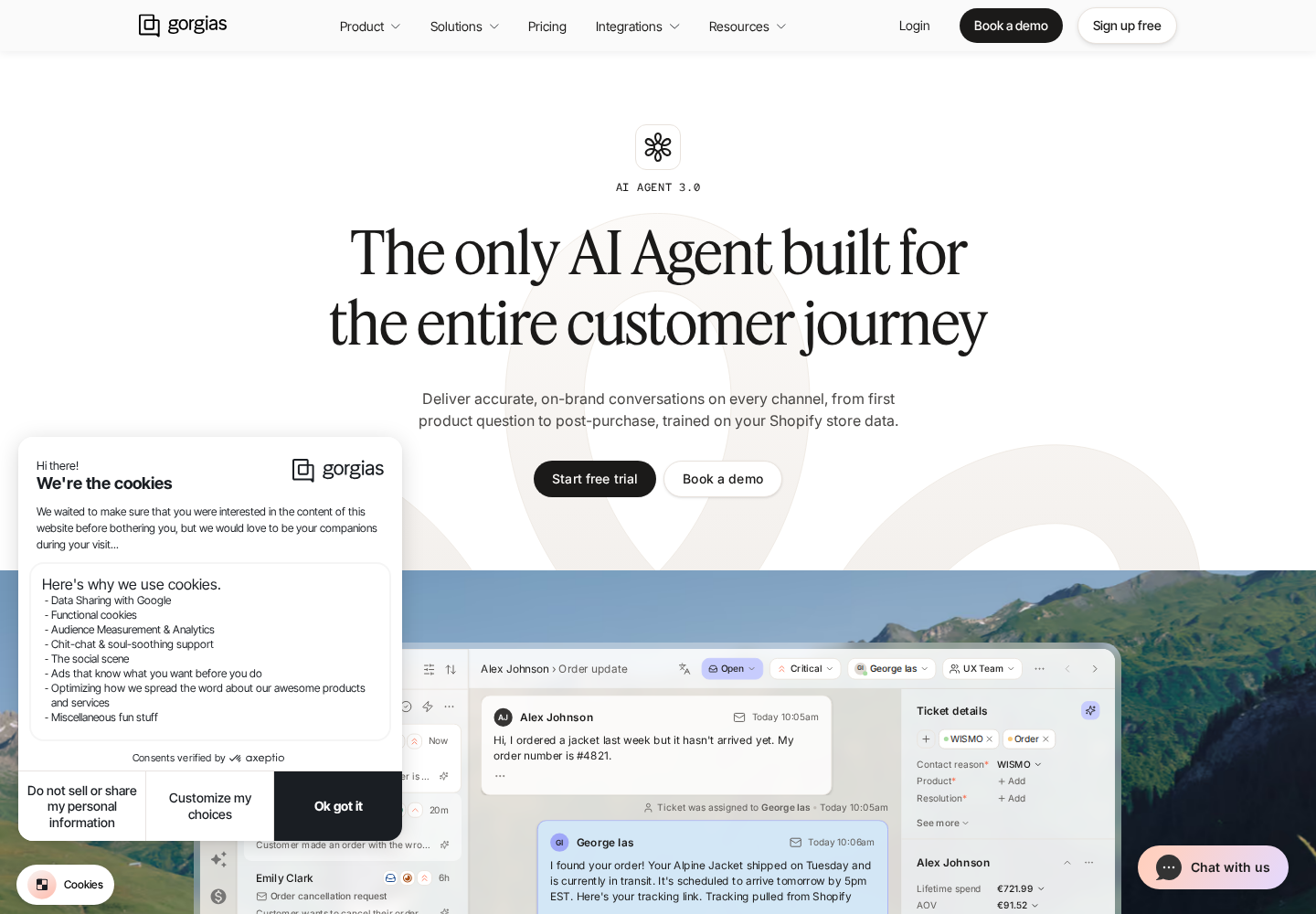
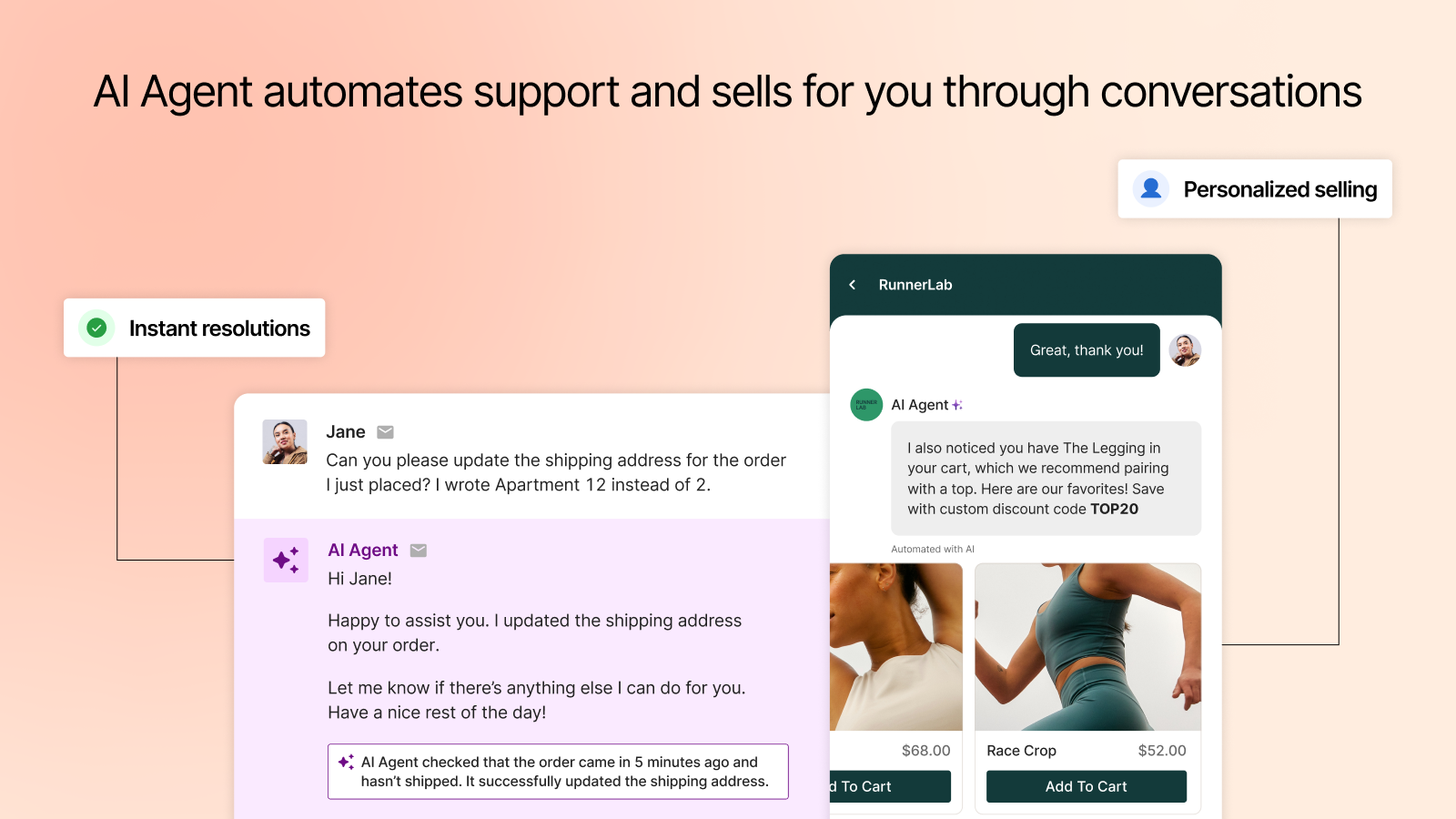
Meaningful capabilities: actions can cancel an order, update an address or work with a connected subscription tool when configured. Gorgias’s setup guide says an action must be included in a skill or guidance before AI can run it. That gives a support lead a concrete implementation task: define eligibility, information required and the point where a person must take over. A documented action is not blanket permission to automate every request.
A specific integration limit: Gorgias documents Skio subscription cancellation and skipping a shipment, but says customers with multiple subscriptions are handed to the team. A shipment can only be skipped before its order is created. For a subscription brand, this documented boundary is more useful than an integration logo: it identifies exceptions that still generate human work.
Cost and implementation: the pricing page describes helpdesk pricing by ticket volume rather than seats. The billing guide says a fully AI-resolved ticket can incur both the helpdesk ticket fee and an automation fee; legacy accounts can follow different rules. Voice and SMS are additional cost categories. Ask for a quote showing your account’s ticket allowance, automated interactions and overages separately. We do not use a universal per-resolution figure where the account model is unresolved.
Choose it over / rule it out: favor a native Gorgias trial over adding a separate assistant when the team already lives in its inbox and order actions are the bottleneck. Compared with Tidio, evaluate the fit of existing processes and connected tools before considering a migration. A founder who mainly needs a few product answers may not benefit enough to justify configuring skills, actions and support operations. Reserve an owner for reviewing outcomes and maintaining exception rules.
4. Rep AI: behavioral selling with configurable sales skills
Positioning and merchant fit: Rep is a candidate for a brand with a growth or merchandising owner who can monitor proactive assistance. Its Shopify listing prices published Sales Skills plans around visitors and catalog size. That makes traffic patterns and campaign economics relevant even when only a small percentage of visitors start a conversation. We would not select it on an assumed revenue uplift.
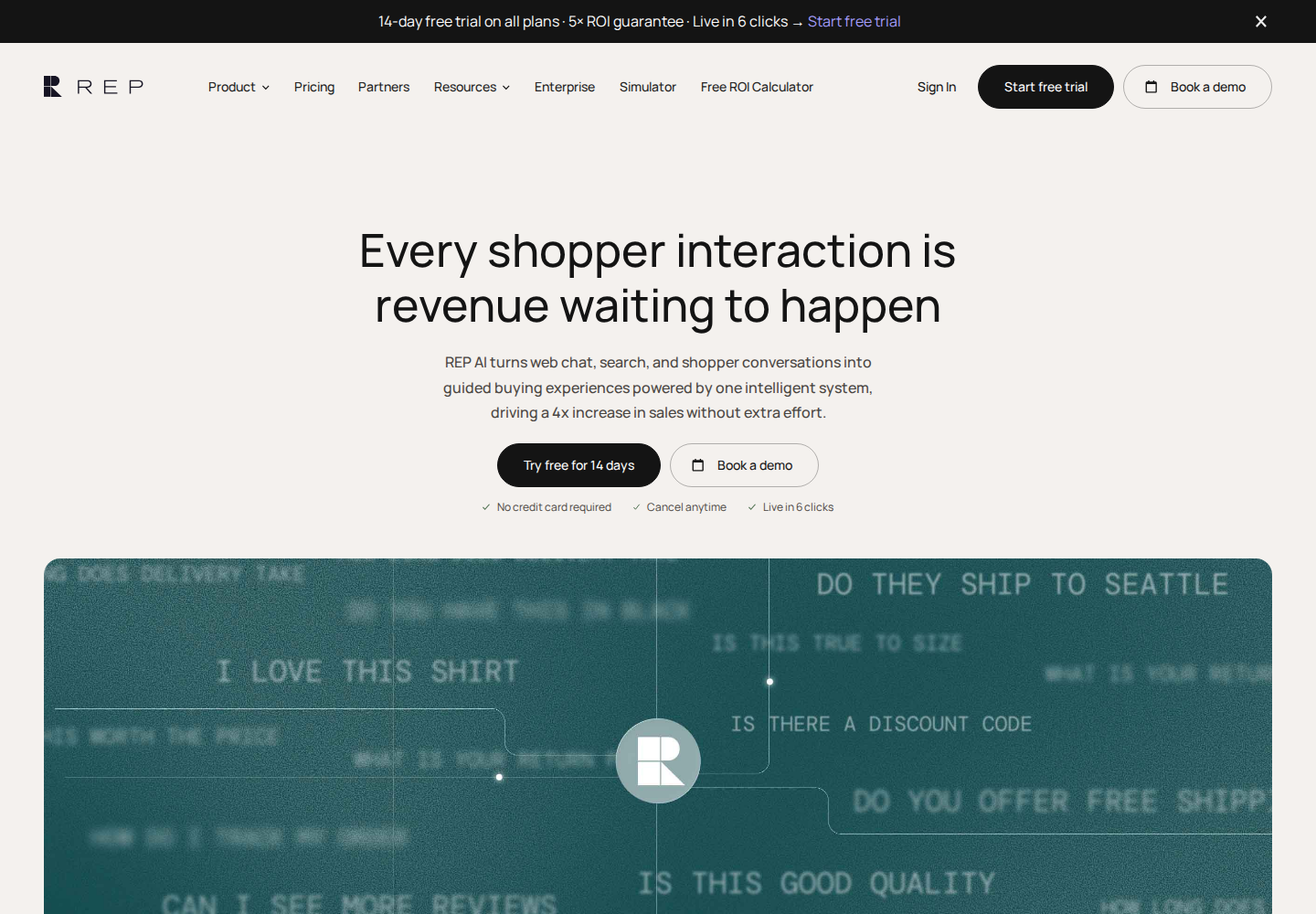
Meaningful capabilities: Rep distinguishes Sales Skills for initiating proactive shopping help from Support Skills for service requests; the Concierge bundle combines them. Product recommendations requested by shoppers and human handoff are documented across the plan types. Therefore, “recommendations included” does not mean proactive sales engagement or automated after-sales actions are included in every package. Rep’s skill definitions.
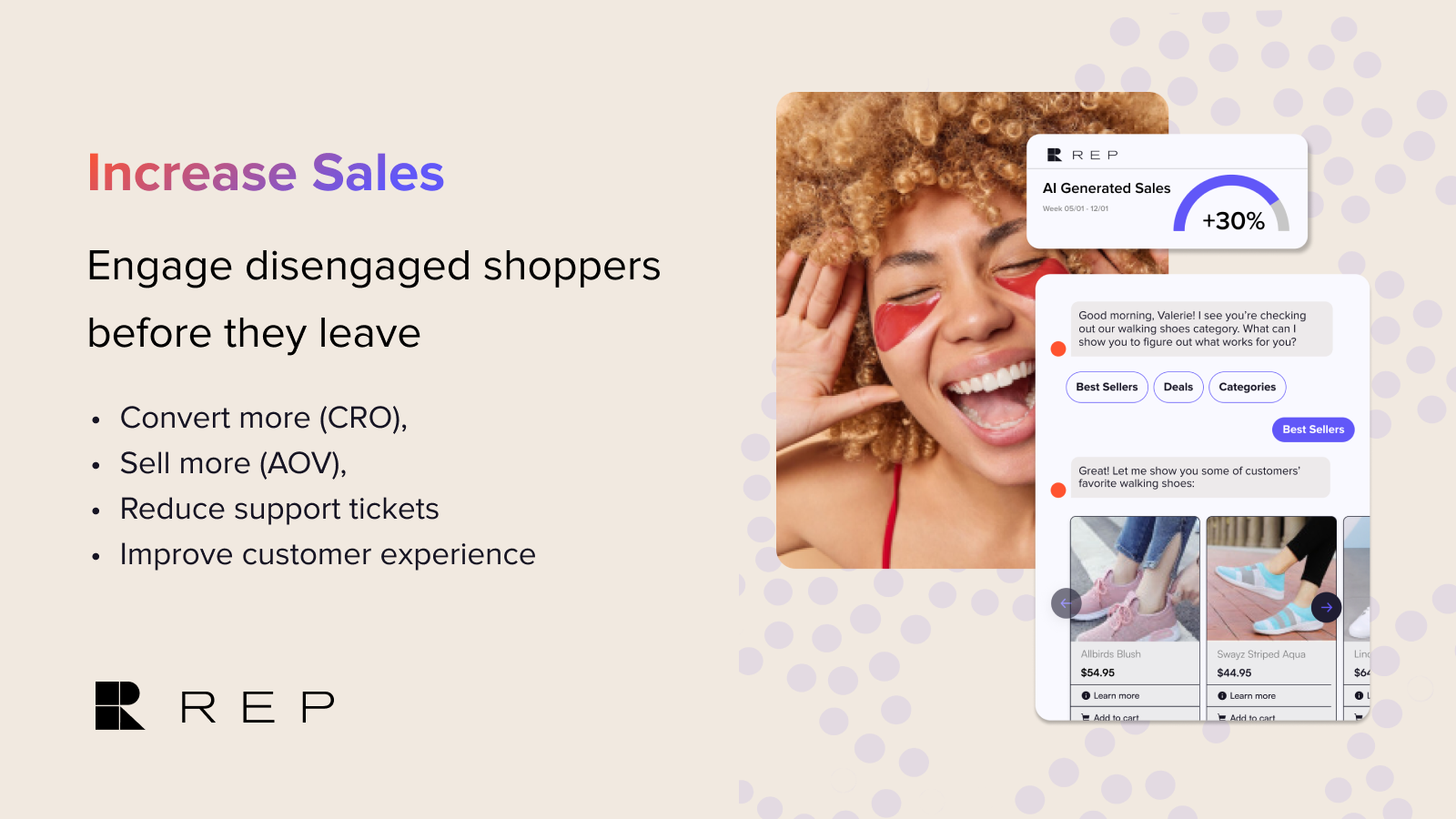
What a growth owner can control: its post-add-to-cart skill includes engagement eagerness and AI instructions; custom behavioral rules require Expert Zone. The Expert Zone guide describes a flow builder, product-finding quizzes and recommendation components. Those controls are worth evaluating when generic prompts are insufficient. Rep also notes that its behavior-based recommendation component can lack data for a new product and needs a fallback. Recommendation documentation.
Plan and cost: the listing shows Starter at $104/month for 10,000 visitors and 1,000 products, with $12 per additional 1,000 visitors. The listed Basic plan is $209 for 25,000 visitors and 2,000 products. Treat these as the published Sales Skills references, not a quote for Sales plus Support plus Expert Zone. An acquisition campaign can change the bill even if conversation volume stays similar.
Choose it over / rule it out: compare Rep with Algoshop when you want behavioral controls and have someone to improve campaigns. Compare the exact paid capabilities, not the two starting prices. If your need is mainly a human inbox with a modest number of FAQs, start with that workflow instead. For a new catalog, inspect recommendation fallbacks; for a high-traffic promotion, approve the traffic budget before launch. Helpdesk integrations listed by Rep still need an end-to-end handoff check in your chosen setup.
5. Chatty: a small-team entry point with meaningful Pro upgrades
Positioning and merchant fit: Chatty is a practical shortlist candidate for a founder or small team combining a chat inbox, FAQs and AI. Its documentation gives useful team-sizing anchors: Free has one seat, Basic five and Pro ten. That does not make the cheapest plan sufficient for every small brand; a two-person apparel store may need advanced shopping functions more than additional seats. Plan comparison.
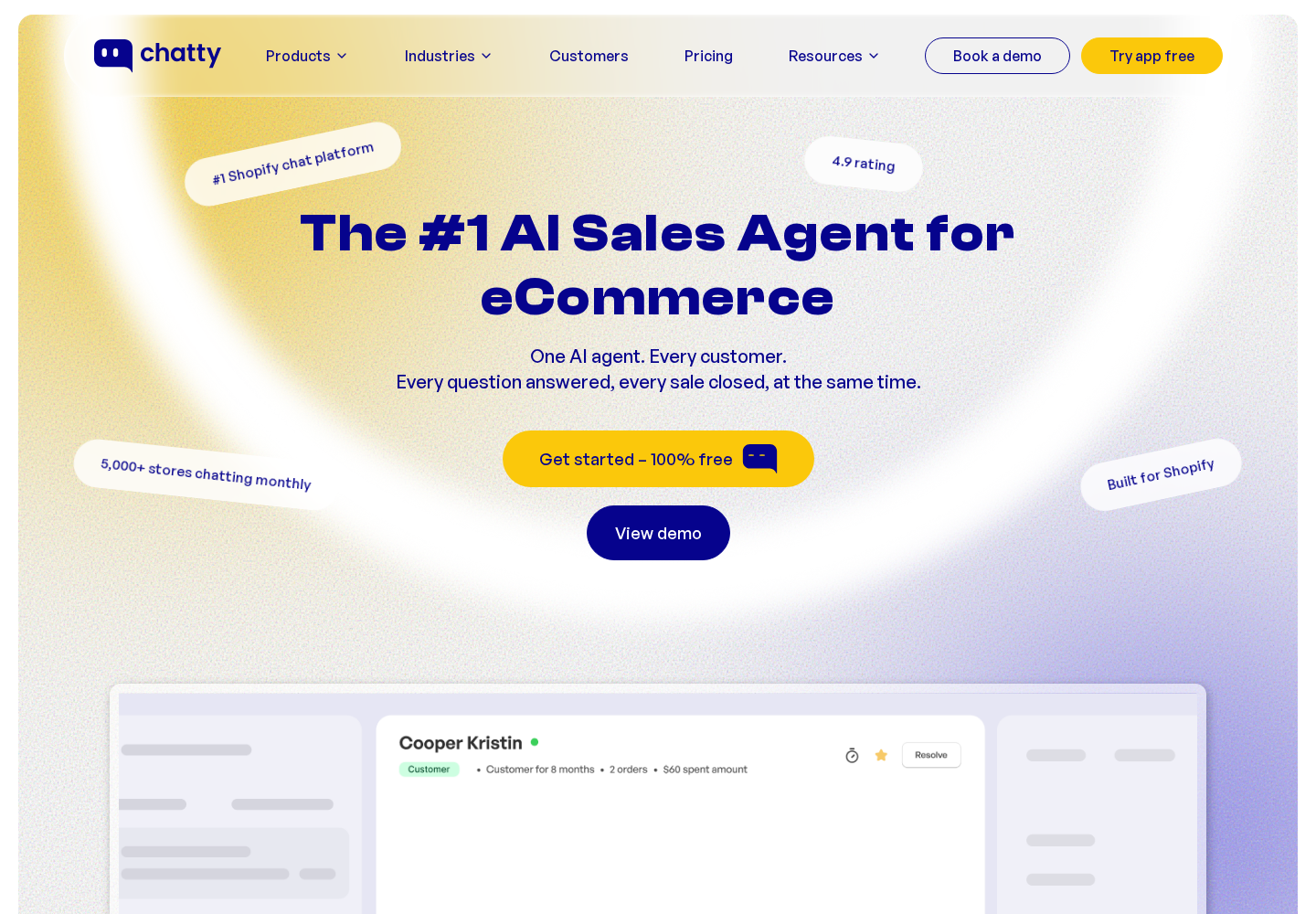
Meaningful capabilities: Chatty distinguishes built-in recommendations, Shopify-related and complementary products, and custom recommendation rules. The custom rules are Pro/Plus features. This matters when you want to direct recommendations toward particular products rather than accept a generic catalog match. Recommendation documentation. Its handover settings separately define when to escalate and where the customer goes, including an in-chat agent or email follow-up. Handover documentation.
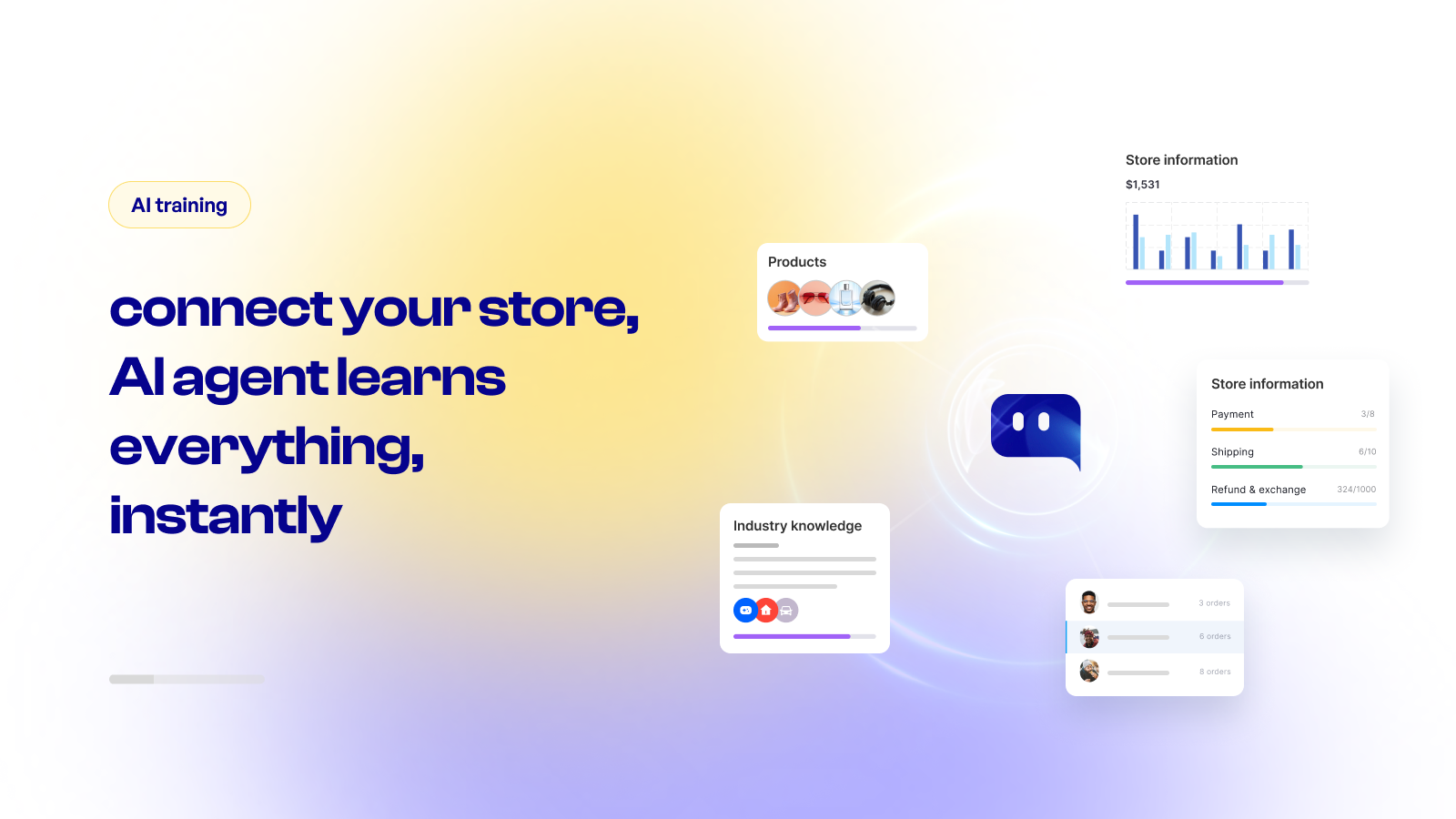
Plan and cost: the App Store lists Free with 50 monthly AI conversations and 200 training products, Basic at $19.99 with 100 conversations, and Pro at $68.99 with 500. Paid overages are $0.40 per AI conversation. The help center’s matrix puts AI handover on paid tiers and multi-market, size-guide and advanced shopping capabilities on Pro/Plus. Basic covers 1,500 training products and Pro 8,000. A catalog limit is an answer-coverage constraint, not just a billing detail.
An integration is not always a live handoff: Chatty’s Gorgias integration documents saving resolved conversations as closed Gorgias tickets with transcripts. It also says resolving a reopened chat creates another ticket. That documented record-sync behavior does not, by itself, establish that Gorgias agents can take over a live Chatty conversation. A team keeping Gorgias must verify the intended agent workflow rather than assume it from the integration name.
Choose it over / rule it out: favor a Chatty trial when its combined seat, catalog and conversation allowance fits a small team’s needs. Compare Tidio when the AI/human workspace and configured actions are the deciding factors. Do not choose Chatty Free for a workflow that depends on paid AI handover, or Basic for custom recommendations. If your company needs live cross-helpdesk takeover, require a demonstrated path before committing.
6. Manifest AI: product knowledge and a connected support layer
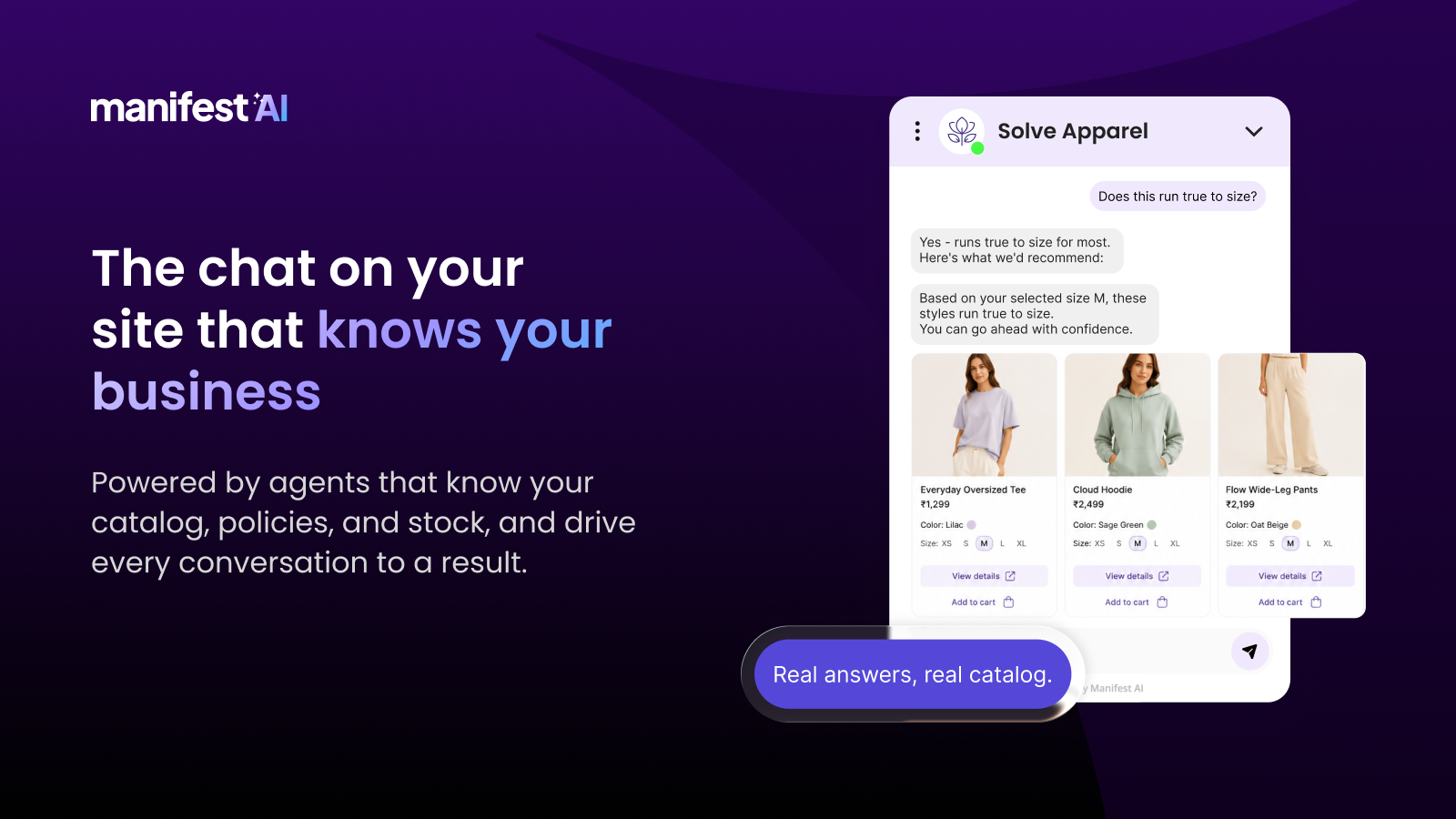
Positioning and merchant fit: Manifest is worth a focused trial when a catalog needs information beyond standard product descriptions and a team member can own training. Its data-source documentation includes product-specific FAQs, PDFs and fetched or manual links, with configurable refresh frequency for fetched store pages. That makes knowledge coverage and maintenance a useful buying lens. We cannot assign it a reliable budget or enterprise-size category from the public price information alone.
Meaningful capabilities: its message-source view exposes information behind answers and links to product or content edits. Its Judge.me integration documents using product reviews in answers and review-based nudges. For a catalog where fit, use and customer experience matter, these are specific capabilities to trial. Review content still needs careful handling: a customer opinion should not become an unsupported product guarantee.
Support connection and limitations: the Zendesk LiveChat guide describes passing conversation summaries to agents. It also lists limited formatting, unsupported hyperlinks and new tickets for returning conversations. These are documented limitations to recheck in a trial, not observed defects from our testing. The setup includes configuring the two systems, so budget integration ownership as well as the assistant subscription.
Catalog controls and price: Manifest’s visibility guide warns that hiding a product or collection through its training visibility control also excludes it from training and recommendations. Verify that a display choice does not remove products you still want recommended. The Shopify listing offers a free-to-test plan; a production price and included usage were not established by the reviewed materials. Keep it off a firm budget shortlist until those terms are supplied.
Choose it over / rule it out: compare Manifest with Rep when knowledge inspection and support connectivity matter more than fine-tuning proactive sales skills. It is less attractive for a merchant who needs a fully priced, low-maintenance decision immediately. A trial should show how a corrected answer changes future responses and how a returning customer reaches the existing support team without losing context.
The closest comparisons: how to choose between them
Algoshop vs Rep: start with the campaign you want to run. Algoshop’s outreach-card formats and social AI tiers suit a campaign-led evaluation; Rep’s separate skill packages and behavioral controls suit a sales-optimization evaluation. Then model your own message volume versus visitor volume. A busy site with few conversations and a smaller site with long consultations can favor different billing structures. Neither starting price establishes better value without the workload and feature package.
Tidio vs Chatty: compare the complete working setup. For Chatty, map seats, catalog size and custom-shopping needs to the tier. For Tidio, map human conversations, Lyro usage and Flows to the required packages. If the bottleneck is correcting recommendations, test each merchandising workflow; if it is escalation, have the same person receive the same difficult conversation in each tool. Shared “AI chat” labels do not answer that decision.
Native Gorgias AI vs an additional assistant: if Gorgias already owns customer support, first establish what its AI can solve in that system. Add another tool only for a specific gap you can demonstrate, such as a desired storefront selling experience. Include duplicate tickets, two knowledge bases, reporting reconciliation and escalation ownership in the decision. A connected app can complement a helpdesk, but an integration logo does not prove it replaces the helpdesk’s AI or agent workflow.
What would the same workload cost?
Illustrative monthly workload, not a vendor benchmark: one Shopify store, 500 products, 10,000 visitors and 500 AI-assisted shopper conversations. For the Algoshop estimate only, assume those chats generate 1,500 billable AI replies, outreach stays below 50,000 impressions and tracking stays within the selected plan. For Chatty, assume all 500 qualify as billable conversations. For Gorgias, assume 500 billable tickets: 300 meet its automation definition and 200 need a human, with no other tickets that month. Taxes, annual discounts, paid external systems and implementation labor are excluded. Each product counts usage differently; the rows are budget checks, not equivalent feature bundles.
| App | Budget for the stated example | Calculation or unresolved input |
|---|---|---|
| Tidio / Lyro | A 500-conversation Lyro tier needs verification | The $39 starting price does not establish this workload’s total. Add the human inbox or Flows package only if required. |
| Algoshop | Essential: $79.90, subject to the stated limits | 1,500 assumed billable replies exceed Starter’s 1,000 allowance and fit Essential’s 3,000. Check all other quotas too. |
| Gorgias AI Agent | Illustrative helpdesk subtotal: $140; AI fees additional | Using App Store Basic: $60 for 300 tickets + 2 × $40 for 200 more. Add the account-specific cost of 300 automated interactions; do not call $140 the AI-inclusive total. |
| Rep AI | Starter Sales Skills reference: $104 | 10,000 visitors and 500 products fit the listed limits. Support Skills or Expert Zone are not assumed included. |
| Chatty | Pro: $68.99; Basic plus usage: $179.99 | Basic: $19.99 + (500 − 100) × $0.40. Pro includes 500. This excludes translation overages and other extras. |
| Manifest AI | Production quote required | Free to test does not establish a paid production budget or allowance. |
Sources: Tidio listing and plan calculator, Algoshop listing, Gorgias listing and billing rules, Rep listing, Chatty listing, and Manifest listing. All calculations are ours. A quote-required row is an evidence gap, not a zero cost.
Two growth surprises: at 1,000 billable conversations, Chatty Pro would be $268.99 under the same overage assumptions; its documented $199 Plus tier includes 1,000, so re-evaluating the plan matters. If Rep Starter stays in place at 15,000 billable visitors, its listed overage arithmetic is $104 + 5 × $12 = $164 before additional capabilities. These examples show why forecasting volume is more useful than ranking entry prices. Chatty pricing; Rep listing.
Check what happens at the ceiling: Algoshop says AI pauses at its quota. Chatty’s Free tier stops AI at the limit, while paid tiers can incur usage charges. Tidio’s free Lyro allowance is non-renewing. Also separate conversations from messages: Chatty documents one qualifying customer conversation per 24 hours, while Algoshop describes counting completed AI responses with exclusions. The same chat log can produce different billable counts. Algoshop limits; Chatty billing definition; Tidio quota.
Setup, maintenance and the cost of changing systems
Before installing, name the person who owns product facts, the person who receives escalations and the person who approves automated order actions. One person can hold all three roles in a small store, but the responsibilities still exist. Begin with the top customer questions and a limited set of products. Expand after reviewing failures, rather than importing a large catalog and assuming coverage.
For selling workflows, maintain product relationships, exclusions, promotional rules and the fallback when an item is unavailable. For support workflows, maintain approved policies, action eligibility and the point where AI must stop. For brands with an existing inbox, verify whether the integration sends a transcript, creates a ticket or supports an active conversation; these are different deliverables. The Chatty-to-Gorgias and Manifest-to-Zendesk examples above show why the distinction matters.
Include internal time in the decision: monthly operating cost equals subscription and usage charges, other required software, plus staff hours spent reviewing answers and handling exceptions. During the pilot, record those hours instead of relying on a vendor’s setup-time promise. Before switching, test knowledge export, ticket history, contact routing and removal of the old widget. Keep ownership of unresolved conversations clear during any overlap.
Run a trial that can change your buying decision
Use the same approved catalog subset, policies and customer questions for the two finalists. Start with 20 representative questions drawn from your own support history, adding exceptions and follow-ups. This is a suggested pilot size, not a statistically reliable accuracy benchmark. The following checks work for general ecommerce brands; add your category-specific cases after these pass.
| Test | What to try | Pass condition |
|---|---|---|
| Product and variant fit | Ask for a product below a budget, then change size or material | Matches available products and the requested variant; respects the original budget |
| Changing facts | Change a price or stock state in the test catalog | Answer and product card reflect the change after the documented sync interval |
| Unsupported request | Ask for a policy exception or an unavailable specification | Does not invent approval; asks for clarification or escalates |
| Authorized action | Try an eligible and an ineligible order-change request in a test environment | Verifies the customer and follows the allowed rules; no unintended order changes |
| Human continuity | Request a person during working hours and after hours | Reaches the intended queue with context; gives a usable offline next step |
| Storefront experience | Use mobile, multiple variants and any required market/currency | Chat and cart work without hiding essential controls or quoting the wrong market |
| Usage and operations | Compare the transcript with the usage dashboard | Explains the charged unit and exposes the maintenance and escalation workload |
Measure useful outcomes: correct answers against your approved facts, successful authorized actions, escalations with usable context, reopened issues and operator time. For sales, distinguish orders associated with chat from incremental sales caused by chat. If traffic permits a controlled comparison, track contribution margin after discounts and app costs; a vendor’s “assisted revenue” figure alone does not establish uplift. Do not combine unlike attribution windows into a single performance ranking.
For personalized-product merchants: add character limits, artwork review, production time versus shipping, and custom-product returns. An assistant answering a question about engraving is different from editing a design and submitting a configured item. A Shopify product customizer and its live preview handle supported personalization choices. We have not verified a direct integration between Podifai and any chatbot in this comparison.
Frequently asked questions
Which app is best for a small Shopify store?
Start with the job you need covered. Chatty is worth comparing for chat and FAQs with explicit team tiers; Tidio for combined AI and human support; Algoshop for proactive sales outreach. A small team can still need an advanced plan because of catalog size, channels or shopping features. Use the scenario and plan limits above to narrow the trial.
Can I keep my existing helpdesk?
Potentially, but check the integration’s actual behavior. Saving a resolved transcript, creating an open ticket and transferring a live conversation are different capabilities. Test the specific connection with an agent in your existing inbox. Include both subscriptions and any duplicate records in the cost assessment.
Does a free plan include ongoing AI usage?
Not always. Tidio’s documented free Lyro quota is a one-time test allowance, while Chatty lists a recurring monthly AI allowance. Manifest’s listing says free to test. Verify renewal, catalog coverage and handoff requirements; “free” alone does not describe an operational support setup.
Can these tools automatically change orders?
Some document configured order actions, but order tracking is not the same as cancellation, refund or address modification. Confirm the exact action, customer verification and eligibility rules. Test it safely with representative exceptions before granting production responsibilities.
Which chatbot will increase conversion the most?
This review cannot establish that. We compared documented capabilities and pricing, not controlled conversion results. Shortlist the workflow that matches your store, then test recommendations, customer experience and incremental margin. More chat-attributed revenue can reflect attribution rules or discounts rather than a better buying experience.