Best Print on Demand Apps for Shopify: 2026 Comparison Guide
Jan 20, 2026
Shopify
Picking a print-on-demand app feels like comparing phone plans—every option claims to be the best, the pricing structures are confusing, and the real costs only become clear after you've committed.
Here's the thing: over 10,000 Shopify stores run print-on-demand businesses, and they're not all using the same app. Different POD platforms excel at different things—product selection, profit margins, shipping speed, print quality. The "best" app depends entirely on what you're selling and where your customers are.
We've looked at the major players, compared actual costs and capabilities, and put together a practical guide for choosing the right POD app for your Shopify store.
Where the POD market stands now
Before comparing apps, some context on where the industry stands.
The print-on-demand market hit $10.8 billion in 2025 and is projected to reach $57.5 billion by 2033. That's not a niche anymore—it's a legitimate business model with proven economics.
About 11.4% of all Shopify stores now run print-on-demand operations. The model works particularly well for merchants who want to sell custom products without inventory risk.
The catch? Only about 24% of POD stores survive past three years. That's roughly the same survival rate as retail businesses generally, which tells you this isn't easy money—but it's also not a lottery. Success correlates with consistent effort and smart platform choices.
Comparing the major POD platforms
Let me break down what each major platform actually offers.
Printful
Printful holds a 4.8-star rating from over 2,251 reviews on the Shopify App Store, making it one of the most-used POD apps available.
What sets it apart: Printful handles most production in-house rather than outsourcing to third-party printers. This gives you more control over quality and delivery consistency. They operate fulfillment centers in the US, Europe, and Mexico, with most products shipping within 2 days and arriving within 5.
Product range: Extensive—clothing, accessories, home décor, tech items. Their embroidery options are particularly strong.
Pricing model: No monthly fees. You pay product base costs plus Printful's margin when orders come in.
Best for: Merchants who prioritize quality control and are willing to pay slightly higher base costs for consistency.
Printify
Printify matches Printful's 4.8-star rating with 2,404 reviews, offering a different approach to the POD model.
What sets it apart: Instead of in-house production, Printify connects you to 80+ print providers across 100+ locations on 4 continents. You can compare base costs across providers and choose who prints each product—useful for optimizing margins or shipping times to specific regions.
Product range: Over 1,300 printable products, one of the largest catalogs in POD.
Pricing model: Free tier available. Premium plan at $29/month (or $299.88/year) gets you up to 20% product discounts—worth it once you hit consistent sales volume.
Best for: Merchants focused on maximizing margins who don't mind comparing providers.
Gelato
Gelato holds a 4.7-star rating with a focus on localized production.
What sets it apart: Gelato prints products as close to the end customer as possible. They partner with 140 printing experts globally and deliver to 200+ countries. About 90% of products reach customers within 5 days.
The environmental angle matters here too—shorter shipping distances mean lower carbon emissions, which resonates with certain customer segments.
Product range: Solid apparel and accessories selection, strong in wall art and prints.
Pricing model: Free plan available. Paid plans unlock better pricing and features.
Best for: Merchants with international customers who want faster delivery times globally.
Gooten
Gooten takes a supplier-network approach similar to Printify but with some key differences.
What sets it apart: 200+ print-on-demand products with a strong supplier network that provides backup production partners. No monthly fees—you only pay when orders come in.
Product range: Solid across apparel, wall art, home décor, drinkware, and accessories.
Best for: Merchants who want supplier redundancy without monthly commitments.
SPOD
SPOD focuses on speed, promising 48-hour production turnaround for most orders.
What sets it apart: In-house production (owned by Spread Group) means faster, more consistent fulfillment. Their 200+ product catalog is smaller than competitors but covers the essentials.
Best for: Merchants where fast shipping is a competitive advantage.
What profit margins are realistic
Let's talk real numbers.
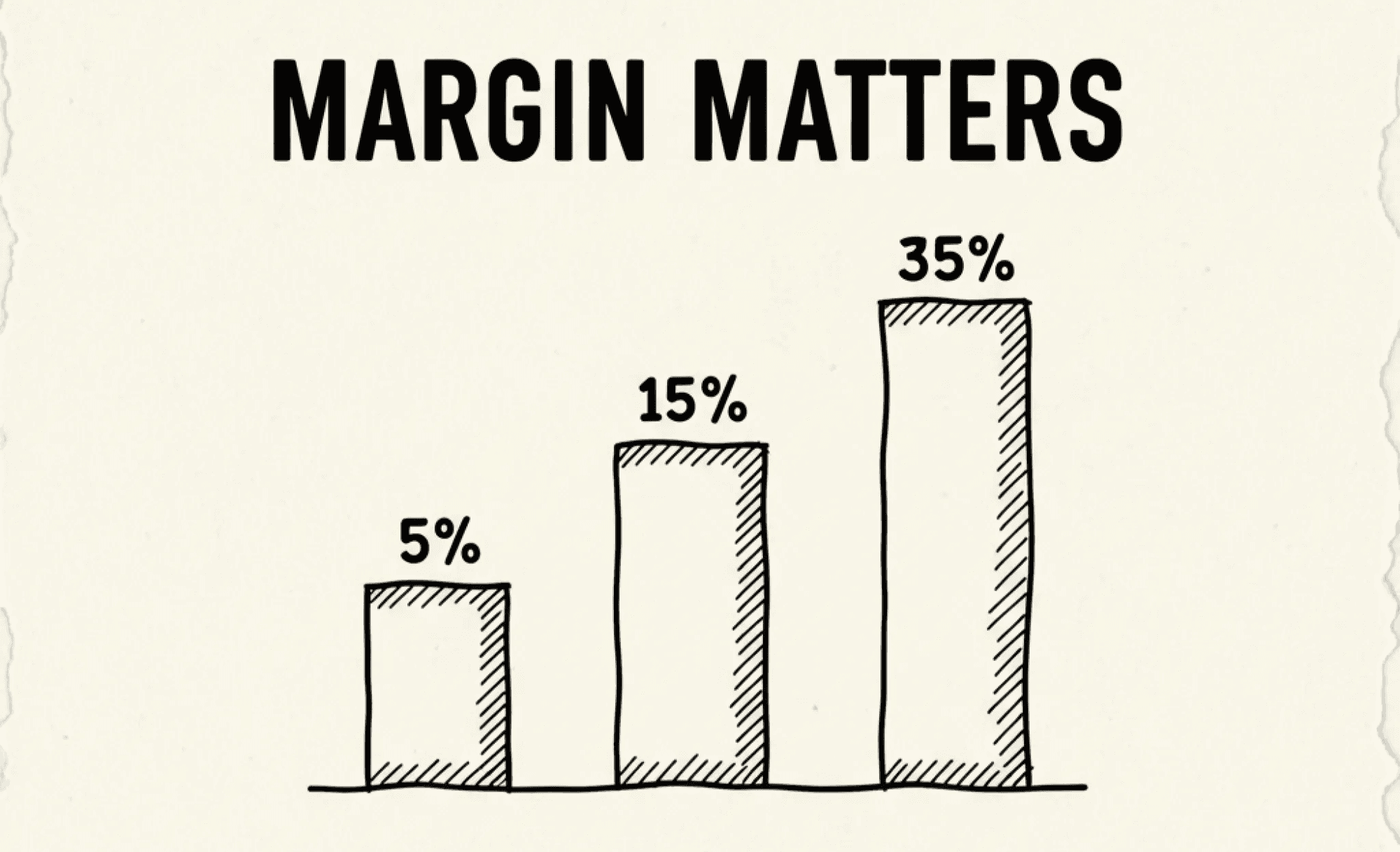
Typical print-on-demand profit margins fall between 20% and 40%. Lower margins are common for competitive basics (standard t-shirts), while premium or personalized products can reach 50% or higher.
Most successful POD merchants aim for 40-45% margins. Here's how that breaks down by product type:
Apparel: 40% is the standard target
Mugs and drinkware: 45% is achievable
Candles: Up to 60% markup
Paper products: Up to 76% markup
The average monthly profit for POD businesses is $4,639, with top performers reaching $9,833 per month according to Gelato's data.
Those averages include a lot of stores doing almost nothing. Active, well-run POD stores typically do better.
How platform choice affects your bottom line
Here's where platform selection matters for your bottom line:
Printify's Premium plan ($29/month) gets you 20% off base costs. If you're doing $500+ in monthly orders, the subscription pays for itself.
Printful's higher base costs get offset by quality consistency—fewer reprints, fewer refunds, better reviews.
Gelato's local production can mean lower shipping costs to international customers, which either improves your margins or lets you offer better prices.
Adding customization for higher margins
Standard POD is straightforward—upload a design, apply it to products, sell. But what about products where customers want to personalize the design themselves?
This is where product customizer apps become relevant. Letting customers add their own text, choose colors, or upload images creates higher-margin products and reduces competition (no one else sells their exact personalized item).
Most major POD platforms support custom text and basic personalization. For more complex customization—like live preview of personalized products—you'll need a product customizer that integrates with your POD workflow.
The margin difference matters: personalized products typically command 20-50% higher prices than standard designs.
Choosing based on your business
Different stores need different things. Here's a decision framework:
You're just starting out
Go with: Printify (free tier) or Gooten (no monthly fees)
Start with zero fixed costs. Test products, find what sells, build some revenue before committing to paid plans. You can always switch or add platforms later.
Quality is your brand
Go with: Printful or AOP+
In-house production means more consistent results. Worth the higher base costs if your brand positioning depends on quality.
You sell internationally
Go with: Gelato
Local production means faster delivery and lower shipping costs to international customers. If 30%+ of your orders go outside the US, this matters.
Speed is your advantage
Go with: SPOD
48-hour production is hard to beat. Useful for time-sensitive products or competing on delivery speed.
You want maximum control
Go with: Printify
Comparing providers, optimizing for cost or speed per product—Printify gives you the most control over the supply chain.
How to actually evaluate quality
Every POD platform claims great quality. Here's how to actually evaluate:
Order samples: Every platform offers sample discounts. Order your best-sellers from 2-3 platforms and compare side by side.
Check print placement: Does the design sit where you expected? Is the sizing consistent?
Wash test apparel: Print quality that survives 5 washes is different from print quality that looks good in photos.
Read recent reviews: Not overall ratings—recent reviews. Quality can change as platforms scale or switch suppliers.
Quality issues often come from design files, not printers. Being clear about print limitations helps manage customer expectations.
Using multiple platforms
Here's something experienced POD sellers figure out: you don't have to use just one platform.
Many successful stores use one platform for their core products (best quality or margins), a second platform for products the first doesn't offer, and a backup platform for redundancy during peak seasons.
Shopify handles multiple POD integrations fine. The main complexity is managing order routing—which usually means setting up routing rules or using a POD aggregator.
Getting started without overthinking
You could spend weeks comparing platforms. Or you could:
1. Pick one platform (Printify or Printful are safe starting choices)
2. Order samples of your planned products
3. Launch with 5-10 designs
4. Iterate based on what actually sells
The POD stores that succeed upload new products consistently—some daily. The platform matters less than consistent execution.
That's the real secret most comparison guides skip.
Ready to add live product customization to your POD store? See how real-time preview works on actual product pages.